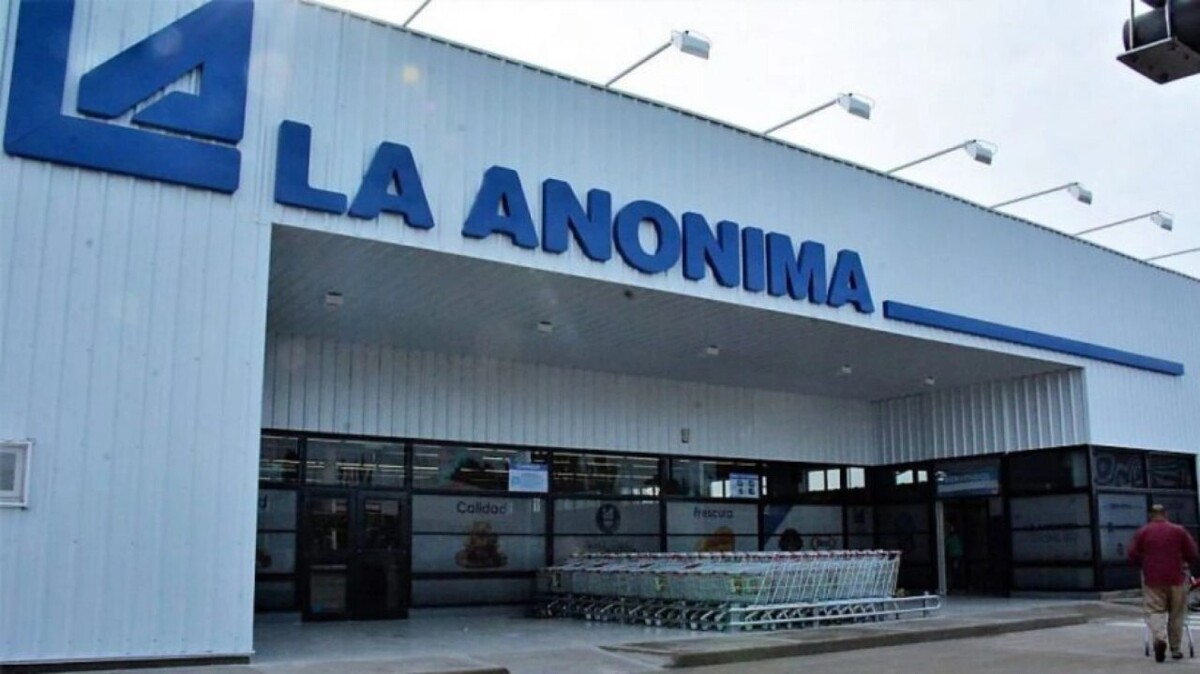
Buenos Aires, Feb 13 (NA) – La Anónima – Sociedad Anónima Importadora y Exportadora de la Patagonia–, the same company that until recently was in talks with other groups for the acquisition of Carrefour's operations in the country, revealed in its balance sheet presented to the National Securities Commission (CNV) on February 9 and 10, that it is facing a decline in sales in its main segment and an alarming jump in the delinquency of its credit portfolio. Despite expansion with new branches in localities such as Reconquista, Resistencia, Fernández Oro, and San Patricio del Chañar, its billing fell by 4.22% year-on-year, which it attributes to the slowdown in consumption, which directly impacted the supermarket business, responsible for 87.39% of total revenue, according to data collected by the Argentine News Agency. The reduced purchasing power of households, affected by accumulated inflation and the loss of real wage value, led to a slump in sales at grocery supply centers. Consequently, the phenomenon that characterizes the national microeconomy of 'tight pockets' was repeated, leading to household debt that, instead of boosting consumption, becomes a financial trap, with 57% of Argentines unable to make ends meet and 22% feeling a loss of control over their finances. The Central Bank had indicated, in this regard, that household loan delinquency reached 8.8% in November 2025, the highest level in a decade, driven by credit aimed at consumption. For credit cards, delinquency reached 8.40%, while for personal loans it exceeded 11%. Financial sector As a result of this trend, La Anónima's financial area, linked to credit cards such as Tarjetas del Mar, which saw a 106.20% increase in income, became its Achilles' heel: the charge for bad debts amounted to $19.255 billion, almost seven times higher than the $2.830 billion from the previous period. The company explains this by the 'increase in customer balances and the delinquency rate', linked to the deterioration in the payment capacity of consumers who finance their purchases through their own or partner cards. The consequence was an increase in delinquency. The charge for bad debts amounted to $19.255 billion, almost seven times higher than the $2.830 billion from the previous period, explained by the 'increase in customer balances and the delinquency rate', linked to the deterioration in the payment capacity of consumers who finance their purchases through their own or partner cards. Weak point The weak point in the finances is fueled by sectoral consumption incentive policies, such as direct discounts: on Mondays and Tuesdays, those who have Plus La Anónima and are beneficiaries of ANSES or the Alimentary Card get a 10% discount at checkout. Rebates for payment methods: using the debit card where they receive their salary, they can receive rebates in their account that, depending on the current promotions of the ANSES Benefits, can reach significant monthly caps (up to $35,000 or $50,000 depending on the program relaunched by the Ministry of Human Capital). Direct discounts: on Mondays and Tuesdays, those who have Plus La Anónima and are beneficiaries of ANSES or the Alimentary Card get a 10% discount at checkout. Rebates for payment methods: using the debit card where they receive their salary, they can receive rebates in their account that, depending on the current promotions of the ANSES Benefits, can reach significant monthly caps (up to $35,000 or $50,000 depending on the program relaunched by the Ministry of Human Capital). This is how the operating result was reduced by 46%, from $22.246 billion to $12.001 billion, while operating expenses increased by 4.21% to $399.290 billion, with a 9.77% increase in remuneration due to collective bargaining agreements and adjustments in staffing. Net profit closed at $9.709 billion, equivalent to 0.65% of income, compared to 1.71% ($25.238 billion) in the previous quarter. Before taxes, the result fell from $34.426 billion to $7.475 billion. As early as May 2025, La Anónima reported a 61% drop in net profits due to the collapse in consumption, with total income falling by 3.93% year-on-year. In its annual balance for July 2025, profits were $31.569 billion, less than half of the $77.530 billion from the previous year, with a gross profit of 27.87% of net income, a decrease of 6.50%. Outlook Overall, the refrigerated segment – which represents 11.79% of income – partially saved the day, showing a robust growth of 57.71%, driven by an increase in international dollar prices and a higher volume of exports. The outlook for a recovery in supermarket sales, which have been declining for six months, is not optimistic. According to Indec, they fell by 3.8% in November 2025. Consultancies like Abeceb forecast a 4% rebound, but based on optimistic hypotheses such as credit recovery and disinflation, which contrast with restrictive monetary policy and the tightening of banking criteria in the face of rising delinquency. Competing chains like Cencosud (Vea and Easy) are also accelerating cuts, with store closures. If forecasts like the IMF's of a 4% economic growth were to materialize, it could boost sectors like mass consumption and retail through opportunities in technology, data, and digital sales. However, analysts like those at Eco Go warn of a stagnation, with risks of contraction if the loss of disposable income due to tariffs and credit restriction persist. For La Anónima, the key will be to strengthen the export business and manage credit risk, while the sector awaits a gradual recomposition of purchasing power.